Where to buy BPC-157: a buyer’s guide to the kinds of sellers, the formats, and what the evidence shows

The short answer
Where to buy BPC-157 comes down to three kinds of seller: telehealth providers that sell it as a compounded prescription, "research use only" websites, and no-prescription sites styled as pharmacies. They differ most in who answers for what is in the vial. The evidence behind BPC-157 itself is mostly animal studies, plus three small human pilots and no controlled trial.
BPC-157 is the peptide most people mean when they talk about “recovery peptides.” It is a short synthetic chain of 15 amino acids, sold for tendon, muscle, and gut repair, and it has one of the loudest followings in the peptide world. It also has one of the widest gaps between enthusiasm and evidence. If you landed here asking where to buy BPC-157, the more useful question is what kind of seller you are looking at, because that decides who, if anyone, answers for what is in the vial. This guide covers the kinds of sellers, the formats, what the research actually shows, the side effects on record, what it costs, and what buyers report going right and wrong, so you can judge a listing on more than its marketing.
Where do people buy BPC-157, and what kinds of sellers are there?
People buy BPC-157 from three broad kinds of seller: telehealth providers and clinics that sell it as a compounded prescription, “research use only” chemical websites, and no-prescription storefronts built to look like pharmacies. A 2025 scoping review describes its spread through medical clinics, compounding pharmacies, and direct-to-consumer sales, and its “continued availability via ‘research chemical’ websites.” What separates the three is not price but accountability: whether anyone reviewed your health history, and whether anyone stands behind the contents for human use.
| What to compare | Telehealth or clinic, compounded prescription | “Research use only” website | No-prescription pharmacy lookalike |
|---|---|---|---|
| Asks for a prescription or health history | Yes | No | No |
| Who answers for the contents | The prescriber and the dispensing pharmacy | Nobody, for human use; the label says so | Nobody you can identify |
| What you can check yourself | Whether the pharmacy is licensed by a state board | A batch certificate of analysis, if one is published | Very little; FDA lists its traits as warning signs |
| Main thing that goes wrong | A prescription does not make the peptide better studied | Identity, amount, and sterility that nobody vouches for | Charges for orders never received, or medicine that looks wrong |
The FDA’s guidance on choosing an online pharmacy gives a simple test that applies to the first and third columns. A pharmacy is likely safe if it always requires a prescription, lists a U.S. address and phone number, has a licensed pharmacist available, and is licensed with a state board of pharmacy. Warning signs include no prescription requirement, no state license, and “prices that seem too good to be true.” When people search where to get BPC-157 more broadly, our guide to buying peptides online walks through the same seller types across every peptide. A prescription route does not make BPC-157 better studied, though: the evidence below applies whatever the source.
What is BPC-157, and why do people buy it?
BPC-157 is a synthetic pentadecapeptide, meaning a chain of 15 amino acids, that was originally isolated from human gastric juice in 1993. The 2025 review in Current Reviews in Musculoskeletal Medicine describes it as having demonstrated regenerative properties in animal models, promoting the healing of tendons, ligaments, muscles, nerves, bones, and other tissues, and notes its “growing popularity among athletes and its wide availability through non-regulated sources.” People reach for it for three main goals: soft-tissue and tendon injuries that heal slowly, general training recovery, and gut complaints, where some users take an oral form. The proposed mechanism is mostly about blood supply and inflammation. In animal and cell work it boosts signaling through the VEGFR2 receptor and nitric oxide production, which supports new capillary growth, and it lowers several inflammatory cytokines, effects the review suggests may matter most in poorly vascularized tissue such as tendon. Our sister site’s BPC-157 overview covers the substance in more depth.
What does the research on BPC-157 actually show?
The evidence is mostly animal and cell studies, with only three small human pilot studies and no controlled human trial. The same review found that only three pilot studies have examined BPC-157 in humans. In a 2021 retrospective study, 14 of 16 people who received knee injections containing BPC-157 (alone or with thymosin beta-4) reported significant pain relief six months to a year later, but the study had no control group, a small sample, and mixed diagnoses. In a 2024 pilot of 12 people with interstitial cystitis who had not responded to the approved treatment, bladder instillations of BPC-157 were reported to resolve 80 to 100 percent of symptoms at six weeks. A 2025 pilot gave intravenous BPC-157 to two healthy adults to measure safety and blood levels, and found it cleared from the blood within 24 hours. The review also notes that every published study reports a positive result, which the authors read as a possible publication bias, and it concludes that until well-designed human trials are published, BPC-157 “should not be recommended for clinical use in musculoskeletal medicine.” In plain terms: promising in rats, untested in any rigorous way in people.
Is BPC-157 safe? The side effects and risks on record
Nobody can say yet, because the human safety record is three pilots with about 30 people in total. Those pilots reported no adverse effects, but that is far too few people to rule out uncommon or long-term harms. The cystitis study screened specifically for fever, rash, nausea, vomiting, and worsening urinary symptoms and found none, and the intravenous pilot saw no meaningful changes in vital signs, ECGs, or liver, kidney, thyroid, or metabolic labs. Researchers still flag theoretical risks that follow from how the peptide works. The 2025 review lists pathologic angiogenesis, the blood-vessel growth that tumors also exploit, along with toxic metabolite formation and nitric oxide overproduction as proposed concerns from lab data, while noting that some animal studies found BPC-157 suppressed VEGF-driven tumor growth instead. An animal safety evaluation could not identify a toxic or lethal dose. Two practical risks sit on top of the pharmacology. One is product quality, which depends on the seller type above. The other is sport: the U.S. Anti-Doping Agency says BPC-157 is prohibited under the WADA list’s S0 category of non-approved substances, and that because it has not been extensively studied in humans, “it is unknown if there is a safe dose.” Our sister site keeps a fuller rundown of BPC-157 side effects.
Injectable, capsules, or a BPC-157/TB-500 blend: how do the formats compare?
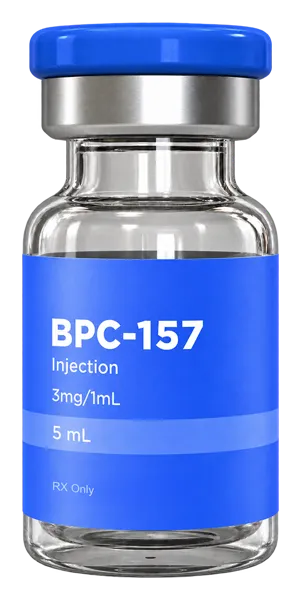
BPC-157 is sold in three main formats: an injectable solution in a multi-dose vial, oral capsules, and blends with TB-500, a fragment related to thymosin beta-4. No study compares the formats head to head, and none of the three human pilots tested a capsule. The table sets out what has and has not been studied for each.
| Format | Route studied | Evidence level, in words | What buyers report |
|---|---|---|---|
| Injectable vial | Injection into muscle and into a vein in rats and dogs; in people, knee injections and one two-person intravenous safety pilot | Animal studies plus two small, uncontrolled human pilots | Worry about contamination and measuring errors when mixing vials at home |
| Oral capsules | No human study; peptides taken by mouth face enzyme breakdown and poor absorption in the gut | No human evidence for this format | Use for gut repair and what posters call leaky gut; personal accounts only |
| BPC-157/TB-500 blend | Only the 2021 knee-injection study, where some patients got BPC-157 with thymosin beta-4; no study of an oral blend | One small retrospective study with no control group | Paired as a recovery stack, with some describing it during recovery from ligament tears and fractures; some say they quit blended vials for single peptides, citing doubts about what is inside |
Two facts frame the choice. First, BPC-157 is short-lived in the body. In the first preclinical pharmacokinetic study, published in 2022, its elimination half-life was under 30 minutes in rats and dogs, and the share reaching the blood after a muscle injection was roughly 14 to 19 percent in rats and 45 to 51 percent in beagle dogs, even though the tissue effects seen in animals persist far longer. Second, oral use is popular for gut complaints because the peptide was first found in the stomach, while injectable use dominates the injury and tendon conversation. Our sister site walks through those trade-offs in its comparison of oral and injectable BPC-157, and covers the most common pairing in BPC-157 vs TB-500. Blends are also where buyers raise the most questions about what is actually inside, a theme in the community section below. For how BPC-157’s formats compare with other peptides sold as capsules, injections and nasal sprays, see our oral vs injectable vs nasal peptides comparison.
What does BPC-157 cost?
Listing prices vary by format and plan length. As of October 12, 2026, one online storefront that routes orders through a telehealth intake lists the injectable vial at $199 a month, and the oral capsule at $242 a month, or $187 a month on a three-month plan; those are listing prices on that date and can change. When comparing any BPC-157 price, check what it includes: whether a clinician reviews the order, and whether anyone is accountable for the contents matching the label, which the next section explains is not the case for “research use only” listings. PeptideAgent’s BPC-157 cost page takes a stricter line and publishes no price at all, on the grounds that no BPC-157 product is FDA approved and a pharmacy has no federal basis to compound it.
What does a “research use only” BPC-157 listing tell you?
It tells you the seller is not standing behind the product for human use. “Research use only” is a labeling category for laboratory products that are not intended for use in or on the human body, so it carries no requirement for verified identity, a standardized amount of peptide, sterility, or medical oversight. The label does not hold up when the same site describes human use: a March 2026 FDA warning letter to an online peptide seller treated products labeled this way as unapproved new drugs because the site’s own pages pointed to human dosing. For a buyer, the practical point is quality: a research-use vial has nobody accountable for what is in it. Our guide to what “research use only” really means covers sterility and dose accuracy in detail.
What do BPC-157 buyers report going right and wrong?
Buyers mostly credit BPC-157 with recovery, and mostly worry about safety and about what is really in the vial. Our Community Insights summaries of BPC-157 and TB-500 discussion, each built from 15 to 16 public posts on X between July 14 and 20, 2026, show the pattern below. These are anecdotes, not evidence.
What buyers say goes right
- Injury and tissue repair. Posters commonly describe taking BPC-157 for tendon, muscle, and post-surgical recovery, including one who started it after a fracture and surgery. They differ on how much of their recovery they credit to the peptide.
- Gut use. Several describe taking oral BPC-157 for gut repair and what they call leaky gut. These are personal reports, and none establishes an outcome.
- The paired stack. Many posts treat BPC-157 and TB-500 as a natural pair, with TB-500 framed as the recovery half and BPC-157 as the gut and tissue half.
What buyers say goes wrong
- A safety debate. One commenter describes collecting about 20 self-reported cancer-like adverse events and links them to the peptide’s VEGF-related mechanism, while openly saying the total number of users is unknown, so no rate can be calculated. Other posters call it very safe. The accounts conflict.
- Doubts about blends. In TB-500 threads, some buyers say they stopped buying pre-mixed stack vials and now prefer single peptides, and some claim products sold as TB-500 often contain full-length thymosin beta-4 instead of the fragment. One says BPC-157 alone worked better for their soreness.
- Preparation and contamination. At least one poster treats mixing mistakes as a real source of contamination and dosing errors and shares a tutorial on clean vial handling.
- Sport. Several posts note that BPC-157 is banned in competitive sport, while others argue it has been unfairly labeled a dangerous research chemical.
Set against the research, the community picture lines up in one place and diverges in another. The recovery stories match what animal studies suggest, but they are the part no controlled human study has tested. And the cancer worry, while unproven, tracks the same angiogenesis question that researchers themselves flag as worth studying.
Red flags when comparing BPC-157 listings
Most of what separates a careful listing from a risky one is documentation. Be cautious when a listing has no batch-specific certificate of analysis from a named independent lab, labels the product “research use only” while explaining how to inject it, makes healing or disease claims, sells a blend without stating the amount of each peptide, or offers nothing on sterility for an injectable. For a seller that presents itself as a pharmacy, add the FDA’s warning signs: no prescription required, no state pharmacy license, and prices that look too good to be true. Our guides on how to read a peptide COA and how to tell if a peptide vendor is legit turn those checks into a short list.
The bottom line
Where you buy BPC-157 decides who answers for the product, but not how well the peptide is studied. It is a genuinely interesting compound with strong animal data and almost no human data: three small pilots, no adverse effects reported in them, no human study of capsules, and a review that calls it investigational. People buy it mainly for tendon, muscle, and gut recovery, in injectable, oral, and blended forms, and the biggest practical risks are the unknowns of long-term use and the quality of what is actually in the vial. If you are weighing it, weigh it on that evidence, and with a clinician who knows your history.
Status: BPC-157 is not FDA-approved; sold by some telehealth providers as a compounded prescription. An FDA advisory committee reportedly voted in July 2026 to recommend allowing pharmacies to compound it; nothing has changed yet. See the peptide status explainer.
Educational information only, not medical advice. Evidence statements are sourced to the peer-reviewed studies and the USADA and FDA documents cited above, and are accurate as of October 12, 2026.
Sources (6)
Advertising disclosure: links marked "Paid link" go to Bodybuilding Peptides (trybbpeptides.com), an affiliate destination, and Peptides in Review may earn a commission if you buy there. Our coverage is independent of that relationship, and nothing on this page is medical or legal advice.
 See it at Bodybuilding Peptides